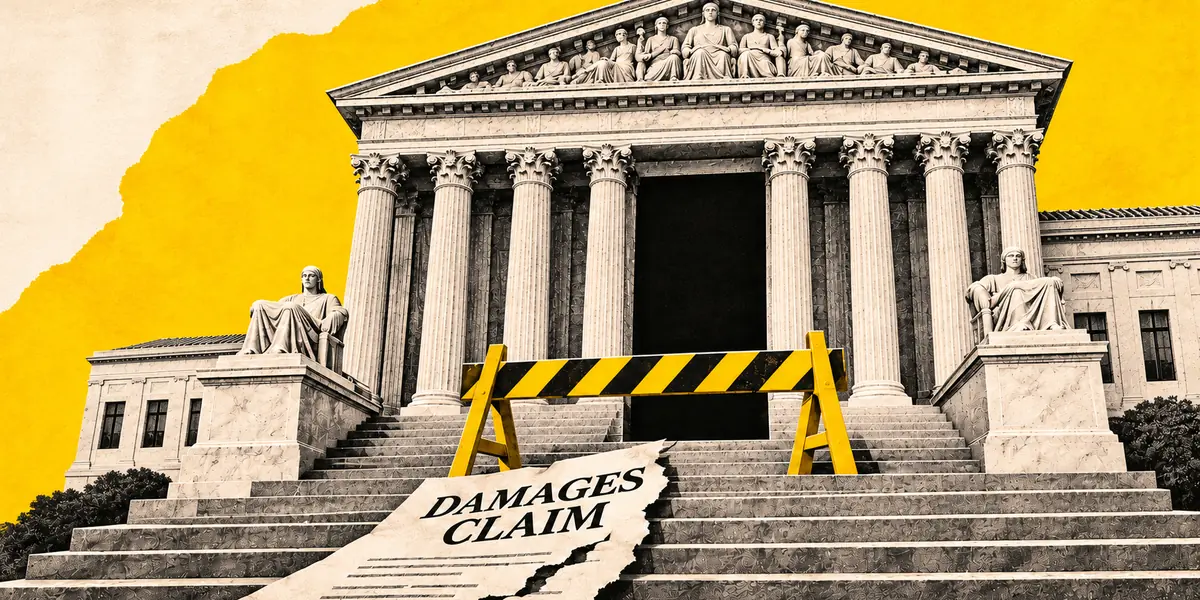
I expect the Court's institutionalists to leave Bivens standing while finding that subsequent legislation has made Carlson obsolete. That would eliminate a damages remedy without overruling the original Bivens decision. Here is the background and why I expect that route. Nielsen v. Watanabe was argued November 9; no decision has issued. [1]
What Bivens Established
In Bivens v. Six Unknown Named Agents of Federal Bureau of Narcotics (1971), a man alleged that federal narcotics agents entered and searched his apartment and arrested him without a warrant or probable cause. The Court recognized a damages action against the individual agents for a Fourth Amendment violation even without a statute expressly authorizing that action. It did not resolve the agents' immunity defense. [2]
What Carlson Added
Carlson v. Green (1980) concerned a prisoner's estate alleging that federal prison officials' deliberate indifference to his asthma caused his death. The Court allowed an Eighth Amendment damages action against the officials. It also held that the availability of a Federal Tort Claims Act claim against the United States did not displace that constitutional claim. [3]
The Issue in Nielsen
Kekai Watanabe alleges that a federal prison paramedic denied needed treatment after an assault, with his injuries later diagnosed as a fractured tailbone. The Ninth Circuit allowed his claim under Carlson. The Supreme Court must decide whether the claim fits that existing precedent or arises in a meaningfully new context where its modern Bivens framework bars an implied remedy. Allowing the claim would not establish liability. [4] [5]
Why Later Legislation Matters
The government's argument is broader than the difference between an asthma emergency and a fractured bone. It contends that subsequent prison legislation and the available remedial framework have made Carlson obsolete. The Prison Litigation Reform Act requires exhaustion of available administrative remedies and regulates prisoner litigation, but creates no standalone damages action against individual federal jailers. The government treats that legislative history as a reason for courts to stop supplying one. [6] [7]
The Counterargument Deserves an Answer
Watanabe argues that Congress legislated around existing Carlson claims, regulating them rather than abolishing them. The Westfall Act makes the federal tort remedy exclusive for many employment-related tort claims but expressly excepts constitutional suits. Watanabe says that exception and the PLRA reflect reliance on the continued availability of existing constitutional claims. An exception is not itself a new damages cause of action; its significance for preserving the old one is disputed. [8] [9]
My Prediction
I think that gives the institutionalists a route they will find attractive: leave Bivens intact, but conclude that the changed statutory setting leaves Carlson with no continuing application. The government's brief expressly invites preserving Bivens for reconsideration in a more suitable case. [6]
That would be a restrained-looking decision with a substantial practical effect. A headline saying Bivens survived could obscure the loss of the prison medical-care remedy.
What I Would Prefer
I have doctrinal concerns about judges creating damages actions that Congress never enacted. I would still preserve the existing remedies, and Congress should enact a durable statutory remedy for constitutional violations by federal officers.
Saying Congress should do the job is a separation-of-powers argument. It is not an excuse for Congress to keep refusing to do it.
Sources & Further Reading
- Nielsen v. Watanabe, No. 25-417 (U.S. argued Nov. 9, 2026), docket.
- Bivens v. Six Unknown Named Agents of Fed. Bureau of Narcotics, 403 U.S. 388, 389-90, 397-98 (1971).
- Carlson v. Green, 446 U.S. 14, 16 n.1, 18-23 (1980).
- Watanabe v. Derr, No. 23-15605, slip op. at 2-5 (9th Cir. Sept. 6, 2024), reproduced at app. 2a-5a in petition appendix, Nielsen v. Watanabe, No. 25-417.
- Egbert v. Boule, 596 U.S. 482, 492-93 (2022).
- Brief for the United States as Amicus Curiae Supporting Petitioner at 2-3, 15-20, 23-28, Nielsen v. Watanabe, No. 25-417 (U.S. Aug. 21, 2026).
- 42 U.S.C. § 1997e(a), (c), (e) (PLRA provisions governing prisoner litigation).
- 28 U.S.C. § 2679(b)(1)-(2)(A) (Westfall Act exclusivity and constitutional-claim exception).
- Brief for Respondent at 16-17, 26-29, 33-38, Nielsen v. Watanabe, No. 25-417 (U.S. Sept. 23, 2026).

Questions About Your Situation?
If a legal change affects your license, firearm rights, or dealings with the government, you can discuss the facts, your options, and the scope of representation with our team.
Schedule a Free Consultation