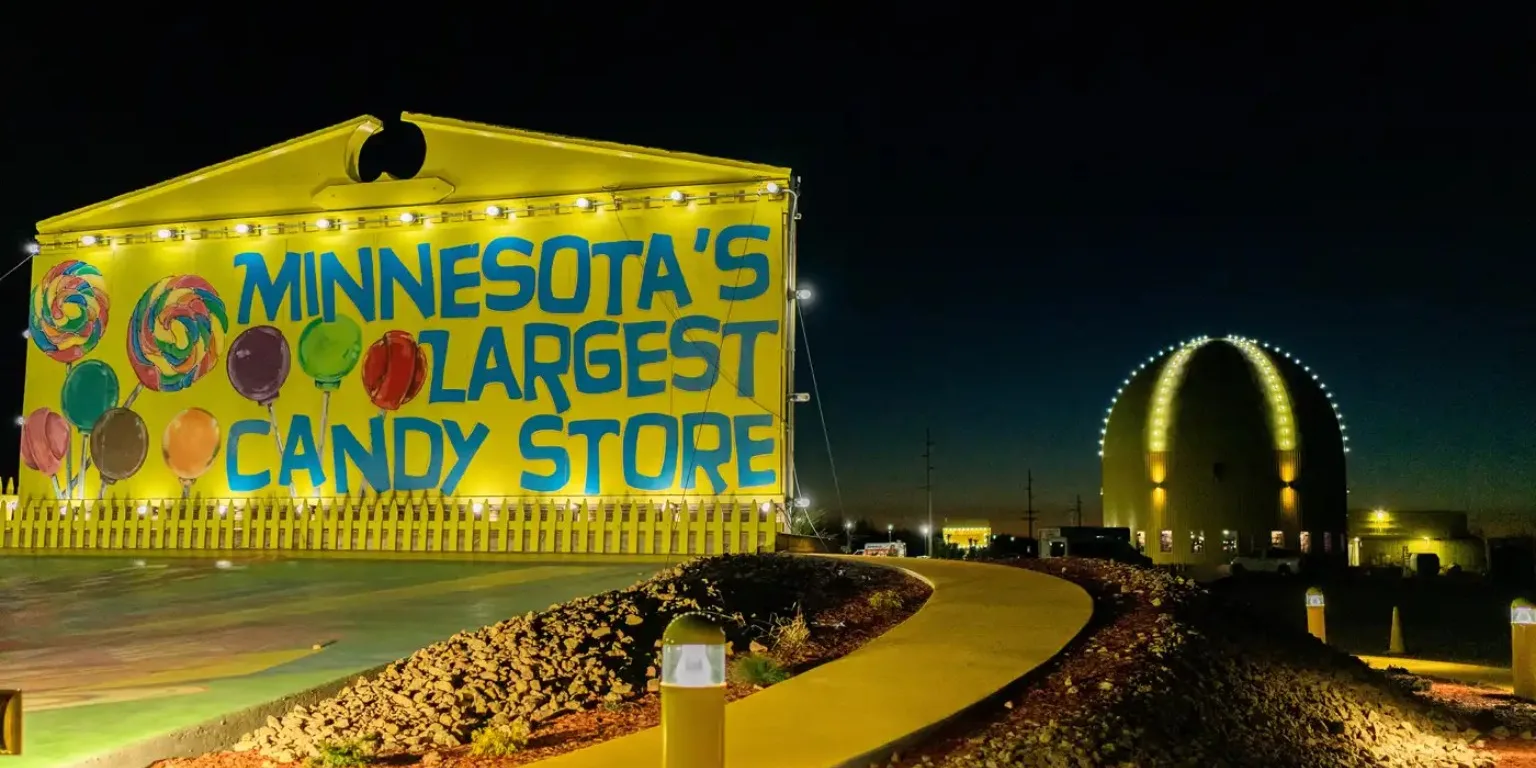
Here's the charging defect hiding in the candy aisle. The actual complaint, State v. Wagner, No. 70-CR-26-16335 (Scott Cnty. Dist. Ct. filed Oct. 27, 2026), alleges that agents bought brandy-filled cherries and whiskey-centered chocolates at Minnesota's Largest Candy Store. It does not charge a violation of Minnesota's specific liquor-filled-candy statute. Instead, it alleges a gross-misdemeanor sale of alcoholic beverages. Those are different statutory categories, and the penalties are different too. [16]
The argument is not that Minnesota allows unlimited liquor-filled candy sales. It doesn't. The narrower question is whether selling a chocolate containing alcohol proves the particular gross misdemeanor the State selected. The State might have an answer, but it needs to provide a statutory one—not a semantic shrug and a picture of a whiskey label. [2] [3] [4] [5]
The Charging Defect Starts with the Words 'Alcoholic Beverage'
Look at Count I itself. It cites Minn. Stat. § 340A.401, with reference to the gross-misdemeanor penalty in § 340A.702(1). The licensing provision broadly prohibits directly or indirectly selling, keeping for sale, and otherwise commercially disposing of alcoholic beverages without the required license. But the penalty provision actually charged is more specific: selling an alcoholic beverage without an authorizing license is a gross misdemeanor. The State must establish an alcoholic-beverage sale and the absence of the required license. Neither provision expressly states a mental-state element. [2] [16] [17]
Chapter 340A defines an alcoholic beverage as a beverage containing more than 0.5 percent alcohol by volume. 'Beverage' is not an incidental word. The objects described in the complaint are chocolate confections. That gives the defense a direct element argument: the State needs to prove that selling those chocolates amounted to selling a beverage, not simply that the confections contained alcohol. [3] [16]

What Counts as Liqueur-Filled Candy?
The same chapter separately defines liqueur-filled candy. Under section 340A.101, subdivision 15b, it is confectionery containing more than 0.5 percent alcohol by volume in liquid form that is intended for or capable of beverage use. That definition raises four factual questions: Is it confectionery? How much alcohol does it contain? Is the alcohol in liquid form? And is the liquid intended for or capable of beverage use? [3]
A solid truffle with alcohol incorporated during manufacture is not necessarily the same product as a chocolate with a free-flowing brandy center. A whiskey syrup center may also present questions about physical form and beverage capability. The labels and manufacturers' descriptions are evidence of a product's composition, but the precise statutory classification should turn on the product itself. [3] [9] [10]
Section 340A.908 then provides that liqueur-filled candy can be sold only in an exclusive liquor store. If these products fit the definition, selling them at a candy store may violate that prohibition. That still leaves a separate question: What crime, at what level, has been committed? [4]
Why the Mismatch May Turn a Gross Misdemeanor into a Misdemeanor
Here is the difference in black and white. Section 340A.702(1) expressly makes an unlicensed alcoholic-beverage sale a gross misdemeanor. Section 340A.908 separately restricts sales of liqueur-filled candy to exclusive liquor stores, but specifies no penalty. Section 340A.703 supplies a default misdemeanor penalty for Chapter 340A violations without a separately specified punishment. If the evidence proves only an unlawful liqueur-filled-candy sale, the apparent statutory path is §§ 340A.908 and 340A.703—not the gross-misdemeanor beverage penalty. That is a charging and grading argument, not an assertion that the candy sale is legal. [2] [4] [6]
The Legislature reinforced the distinction in section 340A.412, subdivision 14(a). Its list of products an exclusive liquor store may sell contains separate entries for alcoholic beverages, liqueur-filled candies, and food products with more than 0.5 percent alcohol by volume. Treating those categories as interchangeable would make the separate entries difficult to explain. [7]
The prosecution's best response is that the liquid inside the chocolate is itself a beverage, so selling the confection also sells an alcoholic beverage. Section 340A.401 also reaches indirect sales and keeping beverages for sale. Those are real counterarguments. But § 340A.702(1), the selected gross-misdemeanor penalty, still requires a sale of an alcoholic beverage. The defense can point out that the Legislature wrote a specific candy rule, identified candy separately from beverages elsewhere, and set a different default penalty. Courts must try to give all those choices meaning when reconciling general and specific provisions. [2] [3] [4] [7] [8] [15] [17]
| Statute | What it addresses | Consequence |
|---|---|---|
| 340A.702(1) | Sale of an alcoholic beverage without an authorizing license | Gross misdemeanor |
| 340A.908 | Sale of liqueur-filled candy outside an exclusive liquor store | No express penalty in this section |
| 340A.703 | Chapter 340A violation when no other penalty is specified | Misdemeanor |
The grading question depends on the offense actually alleged and whether the State can independently prove every element of a more serious provision. [2] [4] [6]
Minnesota Actually Permits Some Alcohol-Containing Candy Sales
Minn. Stat. section 31.76 separately allows certain 'confections containing alcohol' to be sold by an exclusive liquor store or by a business deriving more than half its gross sales from confections. But the definition applies to products with no more than five percent alcohol by volume where the alcohol is nonliquid because it was mixed with other substances during manufacture. It expressly excludes liqueur-filled candy. The statute also requires conspicuous labeling and prohibits sales to people under 21. [5]
In other words, the law does not require every business selling every kind of alcoholic confection to obtain a liquor license. It creates a limited candy-store route for some products and a different, liquor-store-only route for liquid-filled candy. Whether Wagner's products fall on one side of that line is an actual element question, not a matter of branding. [3] [4] [5]
What the Complaint Actually Says About the Chocolates
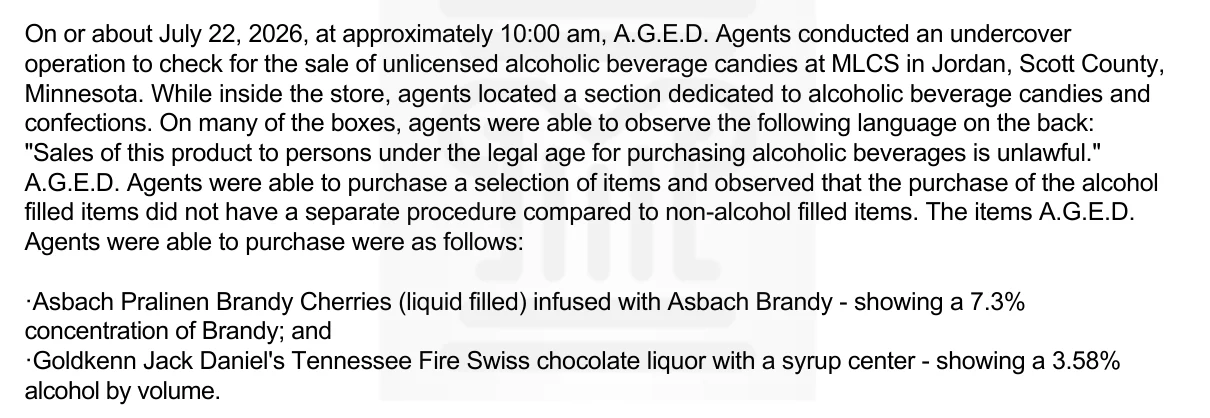
The complaint identifies Asbach Pralinen Brandy Cherries as liquid-filled and 'showing' a 7.3 percent concentration of brandy; it describes the Goldkenn Jack Daniel's Tennessee Fire chocolate as having a syrup center and 'showing' 3.58 percent alcohol by volume. It does not describe a laboratory test, measurement method, or a chemist's conclusion. A percentage of brandy listed as an ingredient is not necessarily the finished candy's alcohol-by-volume figure. A current Asbach product listing identifies 'brandy (7.3%)' in the ingredient list, while a manufacturer product sheet describes the candies as liquid-filled. Goldkenn identifies Tennessee Fire as 10 percent of the ingredients in its syrup-filled chocolate. Those numbers cannot be casually substituted for the statutory ABV measurement. [9] [10] [11] [16]
The State's description of liquid and syrup centers supports its theory that these are liqueur-filled confections. The relevant evidence would include the actual seized product, its ingredient and alcohol disclosures, manufacturer records, and any laboratory analysis. For a probable-cause complaint, the State need not present every piece of trial proof. But the complaint's numbers do not, without more explanation, establish how the legally relevant alcohol concentration was determined. [3] [9] [10] [16]
Who Actually Made the Sale—and What Did the Owner Know?
There is another statutory wrinkle if a clerk, rather than Wagner, completed the purchase. The complaint says agents purchased the candies and met Wagner during a search hours later; it does not identify him as the person operating the register. Section 340A.501 attributes some employee sales to a licensee for regulatory purposes, but expressly excludes the chapter's felony, gross-misdemeanor, and misdemeanor penalty provisions. The State cannot rely on that statute alone to make the owner criminally responsible for every act of an employee. [12] [16]
In State v. Guminga, 395 N.W.2d 344, 346–47 (Minn. 1986), the Minnesota Supreme Court held that imposing criminal liability on a restaurant owner for an employee's liquor sale without the owner's knowledge or consent violated the Minnesota Constitution. This is not a blanket immunity for a proprietor who directs or authorizes illegal sales. Agents say Wagner admitted he was aware the products were stocked and believed the store could sell them. His apparent approval of the inventory makes this argument more fact-dependent than the beverage-versus-candy question. [13] [16]
The gross-misdemeanor provision contains no express mental-state word. The Minnesota Supreme Court generally requires a careful inquiry before reading a serious offense as imposing strict criminal liability. See State v. Ndikum, 815 N.W.2d 816, 818–22 (Minn. 2012). Liquor regulation is also an area with a history of strict-liability offenses. An owner's belief that he complied with the law does not, by itself, resolve the crime's elements. [2] [14]
What About the Alleged Sale to a Minor?
The complaint's investigation began with an anonymous tip alleging a sale to a minor without an identification check. But Count I is the only charge, and it concerns unlicensed selling—not furnishing alcohol to a minor. No purchase involving a minor is described in the agents' undercover operation. The anonymous allegation is not an element of section 340A.702(1). A charging narrative and a charged offense should not be conflated. [2] [16]
My Take
The State may have a perfectly respectable argument that these liquid-filled chocolates belonged in a liquor store. But proving an improper place of sale is not necessarily the same as proving the sale of an alcoholic beverage under the gross-misdemeanor provision. [2] [3] [4] [6]
Now that the complaint is available, the charging issue is no longer hypothetical. Scott County expressly invoked section 340A.401 and the gross-misdemeanor penalty in section 340A.702(1), even though the products alleged are named as liquid-filled confections. The State still owes a statutory explanation for treating those chocolates as beverages when the Legislature separately wrote a rule for liquor-filled candy. The government must prove the offense it charged—not merely identify conduct that seems regulatory enough to prosecute. [2] [3] [4] [16] [17]
There may be a misdemeanor here. The gross misdemeanor is a different question. And that's the interesting legal issue hiding inside an otherwise irresistible headline.
Sources & Further Reading
- MPR News, Owner of Minnesota Candy Store Charged With Selling Liquor-Filled Candy Without a License (Nov. 9, 2026) (reporting allegations of criminal complaint).
- Minn. Stat. § 340A.702(1) (2026) (gross-misdemeanor offense).
- Minn. Stat. § 340A.101, subds. 2, 15b (2026) (definitions).
- Minn. Stat. § 340A.908 (2026) (liqueur-filled candy sales).
- Minn. Stat. § 31.76, subds. 1–2 (2026) (confections containing alcohol).
- Minn. Stat. § 340A.703 (2026) (default misdemeanor penalty).
- Minn. Stat. § 340A.412, subd. 14(a)(1), (6)–(7) (2026) (separate categories sold in exclusive liquor stores).
- Minn. Stat. § 645.26, subd. 1 (2026) (general and special provisions).
- Goldkenn, Jack Daniel's Tennessee Fire Liquor Bar (manufacturer product description and ingredients).
- Rüdesheimer Confiserie, Asbach Pralinen Product Information (manufacturer product specification identifying liquid filling).
- Friars, Asbach Cherry Chocolate Liqueurs 100g (ingredient listing, including brandy percentage).
- Minn. Stat. § 340A.501 (2026) (responsibility of licensee; exception for criminal penalties).
- State v. Guminga, 395 N.W.2d 344, 346–47 (Minn. 1986) (criminal vicarious liability).
- State v. Ndikum, 815 N.W.2d 816, 818–22 (Minn. 2012) (mens rea and strict liability).
- Minn. Stat. § 645.16 (2026) (giving effect to every provision).
- Criminal Complaint at 1–2, State v. Wagner, No. 70-CR-26-16335 (Minn. Dist. Ct., Scott Cnty., filed Oct. 27, 2026) (available in MCRO by case number).
- Minn. Stat. § 340A.401 (2026) (license required; commercial sales and keeping for sale).

Questions About Your Situation?
If a legal change affects your license, firearm rights, or dealings with the government, you can discuss the facts, your options, and the scope of representation with our team.
Schedule a Free Consultation